

















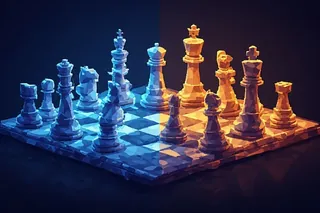
Chess's Chaos Mode Was Built Alongside the Rules, Not After
Explosions, mines, and poison squares layered onto standard chess, with one unbreakable rule: never let it corrupt check detection.
Chaos Mode shipped in the same release as standard chess, not as a follow-up, which was a deliberate bet: build the twist alongside the correct rules engine from day one, rather than bolting it onto a finished game later. That order mattered more than it might seem. If standard chess had shipped first and Chaos Mode came weeks later, every chaos element would've had to be retrofitted around rule-checking code that was never designed to expect a square randomly exploding mid-game. Building both together meant the core engine could be designed to treat "the board state can change in ways the standard rules don't account for" as a first-class possibility from the start.
The rule that mattered most: never break check detection
Explosions, mines, and poison squares are the fun, visible part of Chaos Mode. The actual hard constraint underneath all of them is that none of it is allowed to break check and checkmate detection, which is the one piece of the standard rules engine that has zero tolerance for ambiguity. A mine that removes a piece from the board mid-game has to update every downstream calculation that depends on piece positions — whether a king is currently in check, whether a given move would expose it, whether checkmate has actually occurred — consistently and immediately, not as an afterthought bolted on after the chaos event resolves. I treated the standard rule engine as the one piece of this game that Chaos Mode is never allowed to quietly corrupt, even while everything else about the board is deliberately unstable.
Randomness needed a leash
My first instinct for hazard placement was fully random — mines and poison squares scattered anywhere on the board with even probability. Playtesting that against myself made the problem obvious fast: full randomness occasionally clusters several hazards near one player's starting position and almost none near the other's, which isn't chaotic in an interesting way, it's just an unfair coin flip dressed up as a feature. The placement logic needed constraints — a minimum distance between hazards, and some rough symmetry consideration between both sides — so that a chaotic game still feels like both players are playing the same game, just a stranger one. Chaos was supposed to be the twist on top of a fair game, not a replacement for fairness.
Three hazards, three different relationships to the board
Explosions, mines, and poison aren't just the same hazard skinned three ways — each one interacts with the board differently, which is most of why there are three instead of one. An explosion has area effect, threatening more than just the square it originates from, which makes it the hazard most likely to punish a cluster of pieces rather than a single one. A mine is purely positional — invisible until triggered, and its entire threat is that you didn't know it was there. Poison is the odd one out: rather than removing a piece outright, it degrades something about it over subsequent turns, which meant building actual state that persists and evolves across turns instead of a single instantaneous effect. Having three hazards with three genuinely different shapes of consequence is what keeps Chaos Mode from just feeling like standard chess with a "randomly lose a piece" button attached.
Why chaos events trigger on entry, not on a timer
Hazards trigger when a piece moves onto their square, not on some independent timer ticking in the background. That was a conscious choice about where player agency should live. A timer-based hazard punishes players for things entirely outside their control — you could lose a piece to a random detonation regardless of what move you actually chose. An entry-triggered hazard means every bad outcome traces back to an actual decision: you chose to move a piece onto a square you hadn't scouted, or you were forced into it by the board state, but either way there's a decision in the chain. That distinction is the difference between a chaos mechanic that still feels like a game of skill with unpredictable terrain, and one that feels like the game is just being cruel to you at random.
Standard chess had to stay completely untouched
The single hardest engineering constraint on this feature wasn't any individual hazard — it was making sure a player who never touches Chaos Mode never experiences even a trace of it. Every chaos-specific check needed to short-circuit cleanly when the mode is off, with zero performance cost and zero behavioral difference in standard play. That meant chaos logic had to sit clearly alongside the rules engine rather than woven directly through it — an extra layer that can be skipped entirely, not a set of special cases scattered inside the core move validation that someone reading the standard-rules code later would have to mentally filter out. Chaos Mode gets to be as weird as it wants, exactly because it was built to never leak into the game that isn't asking for it.
I don't know yet whether Chaos Mode ends up being a curiosity people try once or something that becomes its own real preference alongside standard play. What I do know is that it was worth the extra care to build it as a clean layer over a correct engine rather than a set of hacks stitched into one, because that's the only version of this feature where getting it wrong doesn't also put the actual game of chess at risk. Standard chess is centuries old and doesn't need my help being good. Chaos Mode is the part of this release that's actually mine, and it's the part I'll be watching most closely.
More from the Devlog