

















8-Bit SFX Lab: Building an In-Browser Arcade Synthesizer and Tracker DAW with Zero Audio Libraries
How we built a complete retro arcade sound synthesizer and multi-row beat board in pure Web Audio API: procedural waveforms, custom pitch envelopes, Euclidean rhythm generators, musical scale quantizers, and seamless WAV/project export.
Retro games live and die by their sound effects. When Mario stomps a Goomba, when Samus fires a wave beam, or when a laser cannon shatters an alien fleet in an arcade cabinet, you aren't listening to multi-gigabyte orchestral recordings or high-fidelity Foley samples. You are listening to mathematical waveforms generated in real time on sound chips like the Ricoh 2A03 or the AY-3-8910: square waves with alternating duty cycles, 32-step pseudo-sawtooth triangle waves, white noise LFSR registers, and rapid pitch sweeps.
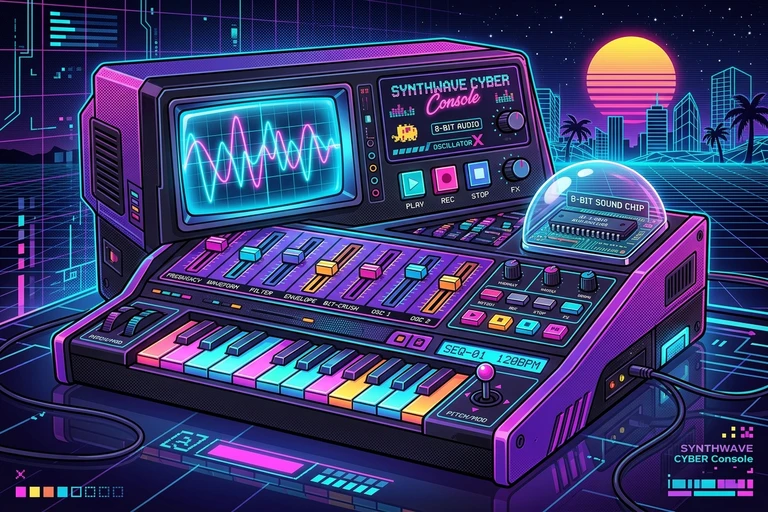
With 8-Bit SFX Lab, I set out to build a comprehensive, zero-dependency arcade synthesizer and multi-track chiptune music tracker directly in the browser. No Tone.js, no Howler, no server-side audio rendering, and no heavy WebAssembly binaries — just pure, high-performance Web Audio API running sample-exact math in client-side memory.
The Architecture: Two Worlds Under One Chassis
Early on, sound generators tended to fall into two extremes. Tools like the legendary sfxr or bfxr excelled at producing isolated one-shot bleeps and explosions, but offered no way to arrange them into songs. On the other side, tracker programs like Famitracker or MilkyTracker provided deep multi-track sequencing, but came with steep learning curves, dense hexadecimal pattern commands, and complex desktop installations.
The 8-Bit SFX Lab bridges those two worlds through a unified dual-engine architecture:
- Sound FX Lab: A procedural synthesis laboratory with dedicated parameter controls for ADSR envelopes (Attack, Sustain, Punch, Decay), frequency modulation (Start Frequency, Minimum Frequency, Pitch Slide, Delta Slide), Vibrato, Arpeggiator stepping, Square Wave Duty Cycle sweeps, and resonant Lowpass / Highpass biquad filters.
- Beat Board Tracker: A multi-row chiptune sequencing digital audio workstation (DAW) where you can build as many instrument tracks as you want, draw rhythmic patterns, tune individual note pitches across 9 musical scales, generate algorithmic Euclidean rhythms, and audition full 8-bit tracks in real time.
- Studio Hub: A clean top menu bar interface inspired by professional desktop DAWs (File, Edit, Board, Scales, Visualizer, Help), featuring quick-load project templates like Boss Rush, Neon Cyberpunk, and 8-Bit Dungeon.
Procedural Waveform Synthesis in Pure Math
Rather than relying on pre-recorded audio samples, every sound in SFX Lab is calculated sample-by-sample into an AudioBuffer. For example, the authentic NES square wave duty cycle modulation isn't an approximation — it calculates the exact phase accumulator threshold:
// Sample-by-sample 8-bit pulse synthesis
for (let i = 0; i < totalSamples; i++) {
  // Frequency slide with acceleration
  freqSlide += deltaSlide * 0.0003;
  currFreq = Math.max(minFreq, currFreq + slide * 2.5 + freqSlide);

  // Arpeggiator pitch modulation
  let effFreq = currFreq;
  if (arpSpeed > 0 && t >= arpSpeed) {
    effFreq *= Math.pow(2, arpMod / 12);
  }

  // Vibrato phase
  if (vibDepth > 0) {
    effFreq += Math.sin(t * vibSpeed * 2 * Math.PI) * vibDepth;
  }

  // Phase accumulation & variable pulse duty cycle
  phase = (phase + effFreq / sampleRate) % 1.0;
  let sample = phase < (dutyCycle / 100) ? 1.0 : -1.0;
  data[i] = sample * envelope * volume;
}
This approach gives you total freedom to shape laser zaps, powerup arpeggios, coin dings, and crunchy noise explosions with zero latency and zero sample loading overhead.
The Timing Problem: Web Audio Lookahead Clock
When people attempt to build a drum machine or step sequencer in JavaScript, they almost always start with setInterval() or requestAnimationFrame(). And almost immediately, they run into musical ruin.
Standard JavaScript timers are subject to event loop congestion, garbage collection pauses, and browser tab throttling. If a user switches tabs or the main thread runs a quick UI calculation, a setInterval will drift by 15–50 milliseconds. In music, a 20ms drift destroys the human groove.
To achieve rock-solid tempo lock, SFX Lab uses Chris Wilson's renowned Web Audio Lookahead Scheduler pattern:
- A coarse JavaScript interval fires frequently (every 25ms).
- It looks ahead into the hardware audio context timeline (up to
audioCtx.currentTime + 0.10s). - Any step notes that fall within that forward scheduling window are queued directly onto hardware-timed
AudioBufferSourceNode.start(targetTime)handles. - The Web Audio thread schedules playback with sub-millisecond precision, completely decoupled from whatever the DOM or the main JavaScript thread is doing.
Musical Scales & Note Tuning
One common limitation in retro beat makers is that sounds are locked to whatever base frequency they were designed with. If you want a melody, you either had to build 12 different tracks or accept a flat monophonic sequence.
In SFX Lab, we designed a full Scale Engine & Note Tuner:
- 9 Musical Scales: Pentatonic Minor, Natural Minor, Major, Blues, Dorian, Japanese Insen (the iconic scale behind 80s arcade ninja and cyberpunk themes), NES Major Arpeggio, NES Minor Arpeggio, and Full Chromatic.
- Root Note Selection: Shift the entire project key across all 12 chromatic pitches (C through B).
- Step Note Tuner Popover: Right-click or tune any active beat in the sequencer to assign an exact note badge (e.g.,
A3,C4,F#4) with an interactive semitone slider (-24 to +24 semitones). - Real-Time Pitch Shifting: During playback, the buffer source node's
playbackRateparameter is adjusted on the fly viaMath.pow(2, semitones / 12), perfectly transposing the authentic arcade timbre without any phase distortion.
Euclidean Rhythm Generation: Geometry in Sound
Writing intricate drum fills and polyrhythms by hand can be tedious. To make beat creation instantaneous, we integrated an algorithmic Euclidean Pattern Generator.
Based on Godfried Toussaint's discovery that Euclid's ancient greatest common divisor algorithm maps directly onto world musical traditions, the generator takes $K$ pulses and distributes them as evenly as possible across $N$ step divisions using Bresenham spacing:
// Euclidean pulse distribution
function generateEuclidean(pulses, steps, rotation = 0) {
  const pattern = new Array(steps).fill(false);
  for (let i = 0; i < steps; i++) {
    // Bresenham integer pulse interval test
    if (Math.floor((i * pulses) / steps) !== Math.floor(((i - 1) * pulses) / steps)) {
      const targetIdx = (i + rotation) % steps;
      pattern[targetIdx] = true;
    }
  }
  return pattern;
}
With Euclidean generation, setting 5 pulses across 16 steps instantly produces an authentic West African and chiptune syncopation; 7 pulses across 16 steps generates a driving Brazilian samba and arcade boss battle cadence.
DAW Ergonomics: Box Selection and Full View Studio
A creative tool should never feel cramped. As you add more tracks to a song, having to scroll up and down past website headers and footers breaks creative momentum.
We solved this through two major workflow enhancements:
- Full View Studio (⛶ / F11): With one click or keystroke, the tool enters a distraction-free desktop studio environment. By integrating the native HTML5 Fullscreen API with a seamless fixed CSS overlay fallback, the website navigation and footer melt away, locking the body scroll and granting the multi-track timeline 100% of the viewport height.
- Multi-Beat Box Selection: Hold Shift and drag a selection rectangle across any combination of tracks and steps. Once selected, you can copy (Ctrl+C), cut (Ctrl+X), paste (Ctrl+V), delete (Del), shift pattern timing ([ / ]), or duplicate right (Ctrl+D) to flesh out full song phrases in seconds.
Client-Side Export: WAV, Projects, and Web Audio Code
A synthesizer is only as good as what you can do with its output. We built a tripartite export pipeline operating entirely in client-side memory:
- Uncompressed RIFF WAV PCM: Encodes genuine canonical 44-byte RIFF WAV headers and interleaved audio data using a
DataViewbinary buffer. Supports both 16-bit signed PCM and 8-bit unsigned PCM at 44.1kHz, 22kHz, or 11kHz. Export individual sound effects, loopable track stems, or the entire mixed song mixdown. - Song & Preset Files (.sfxsong / .json): Save your full multi-track projects or individual sound effect presets to disk. Supports instantaneous drag-and-drop file loading anywhere on the screen.
- Vanilla JavaScript Code Generator: Clicking Code > JavaScript Code Snippet outputs a standalone, dependency-free Web Audio function that you can paste directly into any HTML5 game or canvas project to synthesize that exact sound procedurally in code!
The Boot Sequence Bug and Architectural Takeaway
Right after launch, an elusive bug was caught: players clicked "Play" on the arcade game frame preloader, the loading bar finished and vanished, but the synthesizer console never appeared — leaving an empty void.
Investigating the DOM revealed the culprit: Minnich-Website tools utilize a shared bridge (mc-tool-frame-bridge.js) that listens for the custom "mc-boot-complete" event and runs loaderWrap.nextElementSibling.style.display = "" to unhide the tool container. During template layout adjustments, the preloader macro had been enclosed in a utility wrapper. Because of that wrapper, loaderWrap.nextElementSibling was null — the loader hid itself successfully, but the tool console remained locked at display: none.
We resolved this by restoring the strict sibling hierarchy, adding the standard .mc-tool-frame class, and equipping tool.js with redundant failsafe listeners across window, document, and the loader button. Even if a framework script or event sequence misfires, the studio console is guaranteed to reveal itself smoothly.
Try It Out
Whether you're developing an indie arcade game, producing chiptune music, or just want to craft laser zaps and retro basslines, 8-Bit SFX Lab is live and free to use right now. Fire it up, jump into Full View mode, load up a template, and start synthesizing!