


















Apex Ascent: Re-engineering the Vertical Platformer with Sci-Fi Momentum, Dynamic Audio, and Clean Contrast
How we rebuilt the classic infinite vertical jumper formula into a high-octane sci-fi climb: tuned apex bounce physics, one-bounce crumbling hazards, continuous rocket thruster audio synthesis, and high-contrast cosmic playfields.
There is something fundamentally timeless about the infinite vertical jumper. Ever since the golden era of early mobile gaming, that pure mechanical loop — bouncing on an endless ladder of narrow ledges, calculating trajectories on the fly, and wrapping around the screen edges — has been one of the most addictive kinetic formulas in arcade history. But almost every attempt to recreate it over the past fifteen years falls into one of two traps: either it lazily clones the notebook-doodle aesthetic, or it weighs down the fluid physics with clunky animations, sluggish camera smoothing, and visual clutter.
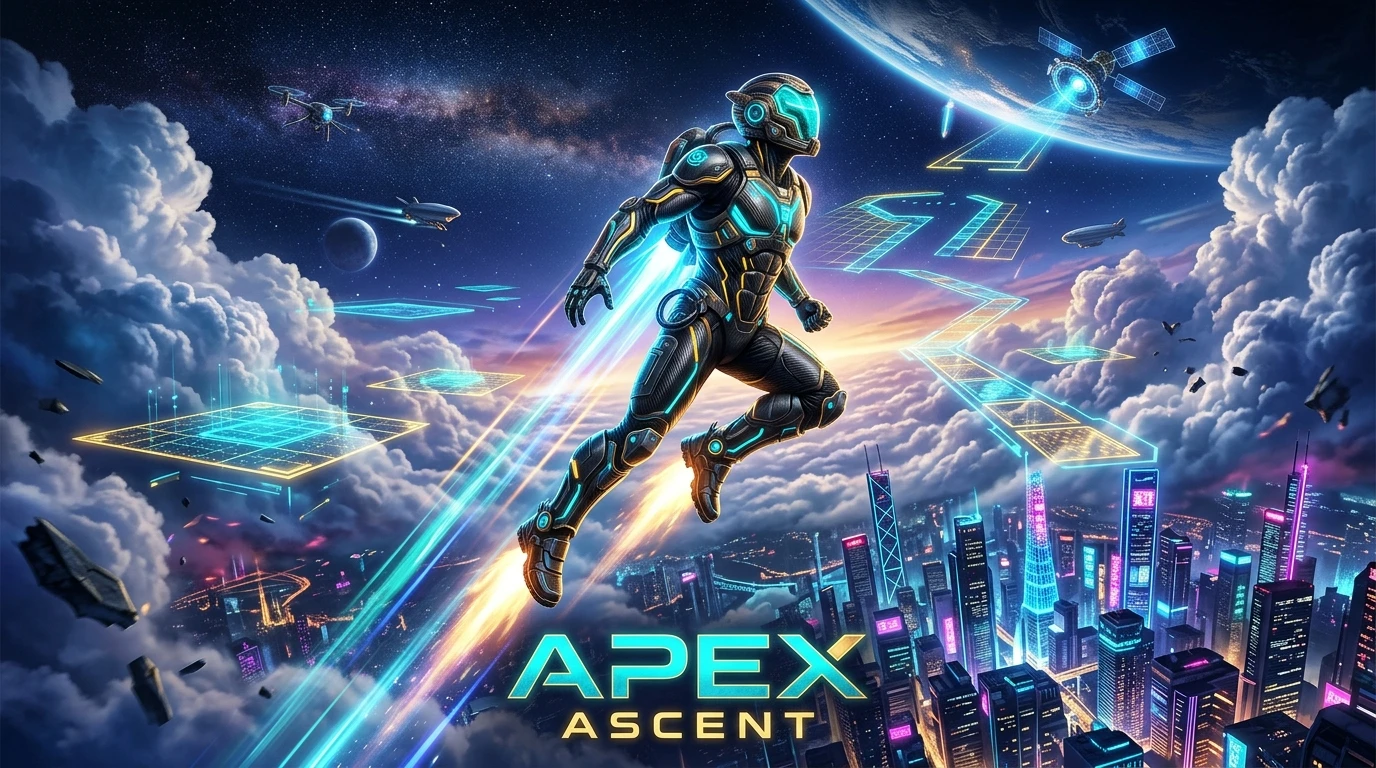
With Apex Ascent, I wanted to strip away the hand-drawn gimmickry entirely and ask a different question: what if you built a vertical jumper with the responsive inertia of a precision arcade platformer, high-detail sci-fi cybernetic assets, dynamic combat, and authentic Web Audio sound design? Here is the full story of how Apex Ascent came together, what broke in early playtests, and the design decisions behind the climb.
The physics of the ascent: gravity, apex hangtime, and horizontal inertia
In a vertical jumper, physics isn't just a backend calculation — it is the entire game. If gravity pulls too hard, the jump feels heavy and abrupt; if gravity is too weak, the player feels like they are swimming through molasses, completely detached from the danger of falling.
After dozens of test runs, we tuned the simulation around three precise constants:
-
Gravity (
0.38 px/frame²): Light enough to grant a generous parabolic arc, but steep enough that a missed platform turns into a heart-stopping descent within a third of a second. -
Standard Bounce Impulse (
-13.2 px/frame): Engineered to launch the avatar approximately 230 pixels vertically — providing just enough vertical clearance to reliably scan and reach the next 2–3 generated tiers. -
The "Apex Hangtime": Near the vertex of the jump where vertical velocity approaches zero (
|vy| < 1.5), the player spends approximately 120 milliseconds in near-zero-G suspension. That microscopic window is where all the agency lives: it is where you read the screen, spot a moving platform, and nudge your trajectory across the screen boundary.
Horizontal movement also required a fundamental design choice. Many mobile jumpers use raw tilt sensors or instant snapping where pressing left snaps your velocity immediately to max speed. In Apex Ascent, we implemented a responsive inertial model:
const MOVE_SPEED = 7.4;
const ACCEL = 1.35;
const FRICTION = 0.88;
if (keys.left) {
player.vx = Math.max(player.vx - ACCEL, -MOVE_SPEED);
player.facing = -1;
} else if (keys.right) {
player.vx = Math.min(player.vx + ACCEL, MOVE_SPEED);
player.facing = 1;
} else {
player.vx *= FRICTION;
}
With an acceleration of 1.35 and friction of 0.88, turning feels snappy and immediate, but releasing the key gives you a slight micro-slide. You can "feather" your momentum onto the very tip of a narrow ledge without feeling like the character is stuck to a grid.
Solving the "AI background" problem: contrast and peripheral readability
One of our earliest prototypes looked incredible in static screenshots: hyper-detailed futuristic cityscapes, dense neon skylines, and glowing orbital towers. But the moment you actually played it, the game fell apart.
Detailed background illustrations create a massive amount of high-frequency visual noise. In a game where platforms scroll past at 1,000 pixels a second, your eyes rely on peripheral contrast to identify safe footing. With dense skyscrapers behind the action, blue and grey metal platforms camouflaged directly into window frames and rooftop antennas. Players were missing jumps not because their timing was off, but because their brains literally could not parse the platform edges in time.
We solved this with a three-pronged visual hierarchy overhaul:
- Clean Procedural Starfield: We scrapped the cluttered backdrop images during active gameplay in favor of a clean, high-contrast cosmos backdrop featuring multi-layered twinkling stars with subtle vertical parallax. The deep black-and-navy void provides an immediate, uncluttered canvas.
-
Drop Shadows for Depth Separation: Every platform is rendered with an intense ambient drop shadow (
rgba(0, 0, 0, 0.85)with a 10px blur radius). This creates an unmistakable visual separation between the platform foreground and the background cosmos. - The 3px Neon Highlight Bar: Along the top collision surface of every platform, we render a vibrant, high-luminance highlight bar (cyan for standard, violet for moving, crimson for fragile). Even if you are tracking an enemy drone at the top of the viewport, your peripheral vision instantly registers the landing line below you.
Platform hazard tuning: the 1-bounce crumble rule
In traditional vertical jumpers, "broken" platforms are often designed to shatter instantly upon impact, offering zero upward bounce and sending the player plummeting to their death if they land on one.
In playtesting, instant-shatter platforms felt cheap and frustrating rather than challenging. If procedural generation spawned two moving platforms and a fragile platform across a wide gap, mistiming a jump into a zero-bounce hazard meant instant game over with no counterplay. Conversely, allowing fragile platforms to bounce repeatedly removed all risk.
The solution was the One-Bounce Crumble Rule:
-
When your boots hit a red fragile platform, the collision sensor registers a successful bounce, launching you skyward with full jump velocity (
-13.2 px/frame). -
At that exact millisecond, the platform triggers a concussive fracture: the platform object is immediately marked
p.isBroken = true, a crisp structural snap audio cue plays, and nine jagged crimson shards rain downward into the abyss. - The platform completely ceases to exist in the world. You got your bounce — but you have burned your bridge. If you fail to find a platform at the apex of that bounce, there is no safety net waiting below.
This dynamic turns fragile platforms from annoying "gotcha" traps into tactical springboards. Advanced players deliberately route through red platforms to bridge impossible gaps, knowing they must execute their next landing with zero hesitation.
Combat and aerial hazards: plasma blasters and drone stomps
Starting around an altitude of 1,200 meters, autonomous Sentry Drones begin patrolling the vertical airspace. Equipped with twin rotors and glowing crimson sensor eyes, they hover along oscillating sine waves across the corridor.
To handle them, your cybernetic pilot is equipped with an integrated wrist plasma blaster. Tapping anywhere on the screen (or pressing Space / W / ↑) fires high-speed plasma bolts straight up or angled toward your cursor, vaporizing drones into glowing blue debris for +300 points.
However, the most satisfying mechanic in the game is the Aerial Stomp. Inspired by classic platformer mechanics, if you fall onto a sentry drone from above (vy > 0 with your boots contacting the drone's top dome), you don't take damage — you stomp the drone out of the sky:
if (player.vy > 0 && player.y + player.height / 2 < curDroneY + 18) {
player.vy = JUMP_VELOCITY * 1.35; // Massive +35% jump boost
destroyDrone(d, curDroneY, "+500 STOMP!");
currentScore += 500;
drones.splice(i, 1);
}
Stomping a drone grants a massive +500 score reward and launches you into a super-bounce (-17.8 px/frame), rocketing you past entire tiers of platforms. It transforms what would otherwise be a dangerous obstacle into a high-risk, high-reward shortcut.
Synthesizing rocket thrusters in the Web Audio API
When you collect a rocket booster pack on a platform, your character ignites twin back thrusters and surges upward at extreme speed (-17.5 px/frame) for 4.5 seconds of total invulnerability, ramming through sentries and obstacles.
In early builds, the rocket sound was synthesized using a repeated sawtooth oscillator chirping every 80 milliseconds. In practice, it sounded harsh, tinny, and exhausting to the ears — like a broken dial-up modem rather than a roaring afterburner.
We completely tore down that audio loop and rebuilt it using a continuous, stateful Web Audio synthesis chain:
const bufferSize = Math.round(audioCtx.sampleRate * 1.5);
const noiseBuffer = audioCtx.createBuffer(1, bufferSize, audioCtx.sampleRate);
const output = noiseBuffer.getChannelData(0);
let lastOut = 0.0;
for (let i = 0; i < bufferSize; i++) {
const white = Math.random() * 2 - 1;
output[i] = (lastOut + (0.03 * white)) / 1.03;
lastOut = output[i];
output[i] *= 3.2;
}
// Route through resonant lowpass filter + sub-bass sine oscillator
filter.type = "lowpass";
filter.frequency.setValueAtTime(480, now);
filter.Q.setValueAtTime(2.5, now);
subOsc.frequency.setValueAtTime(56, now); // 56Hz sub-bass rumble
By combining a continuous looping pink noise generator with a resonant 480Hz lowpass filter and a dedicated 56Hz sub-bass rumble oscillator, the jetpack delivers a deep, satisfying sci-fi thruster roar. When the rocket timer expires, or when the player pauses or falls, the audio gain exponentially ramps down over 200 milliseconds, eliminating any jarring clicks or pops.
The soundtrack: main menu interaction gating
Modern browser autoplay policies strictly forbid playing unmuted audio before a user has interacted with the document. But beyond technical compliance, audio timing is an artistic choice: having music blast through headphones the instant a webpage loads is jarring.
We wired the game's synthwave soundtrack (apex_ascent.mp3) with an explicit interaction gate:
- Playback is completely dormant on initial page render.
- The soundtrack only initiates when the user takes an intentional action on the Main Menu screen — touching or clicking anywhere on the menu card, pressing a key, or clicking Launch Mission or Field Manual.
-
Once active, the soundtrack loops seamlessly through gameplay, pause states, and mission debriefs, fully synchronized with the global audio toggle button (
🔊 / 🔇) and pause screen controls.
Seamless screen wrapping: the ghost render pass
In any vertical jumper, screen wrapping is a core survival tactic: stepping off the left playfield border instantly teleports your avatar to the right border.
However, naive implementations create an ugly visual pop: the sprite clips abruptly against the left edge, disappears entirely for a frame, and then suddenly appears on the right edge. With larger, detailed sprites (64 × 84 px), this pop is glaringly obvious.
Apex Ascent solves this with a secondary Ghost Render Pass:
if (player.x - player.width / 2 < playfieldLeft) {
renderPlayerGhost(player.x + playfieldWidth);
} else if (player.x + player.width / 2 > playfieldRight) {
renderPlayerGhost(player.x - playfieldWidth);
}
Whenever the character's bounding box intersects either border, the engine renders an identical ghost clone offset by exactly one playfield width — complete with equipped rocket thrusters, forcefield shield bubbles, and orientation squashing. The character visually exits one side of the screen while simultaneously entering the other with pixel-perfect continuity.
Minnich.Awesome arcade integration
Like all flagship titles on Minnich.Awesome, Apex Ascent is fully wired into the site's unified arcade infrastructure:
-
GameHUD Standard: Mounted directly in the top-left corner using
window.GameHUD.mount(view, { mode: 'health' }), displaying real-time suit integrity (100 HP) and dynamic altitude scoring. -
Global Leaderboards & Local Storage: At the moment of casualty, final scores are evaluated and submitted to
window.Highscores.submit("apex-ascent", score)with automatic fallback to local high score records. -
Achievement Hooks: Registered in
webapp/achievement_rules.pywith Apex Rookie (reaching 2,500m) and Apex Ace (surpassing 10,000m).
Ascending into the future
Building Apex Ascent proved that a decades-old arcade formula still holds incredible potential when treated with modern game feel discipline. By pairing tuned parabolic physics, high-contrast visual hierarchy, one-bounce hazards, and real-time Web Audio synthesis, the climb never loses its edge-of-your-seat momentum.
Grab your flight suit, watch those fragile red platforms, and we'll see you at the top of the stratosphere.
More from the Devlog