

















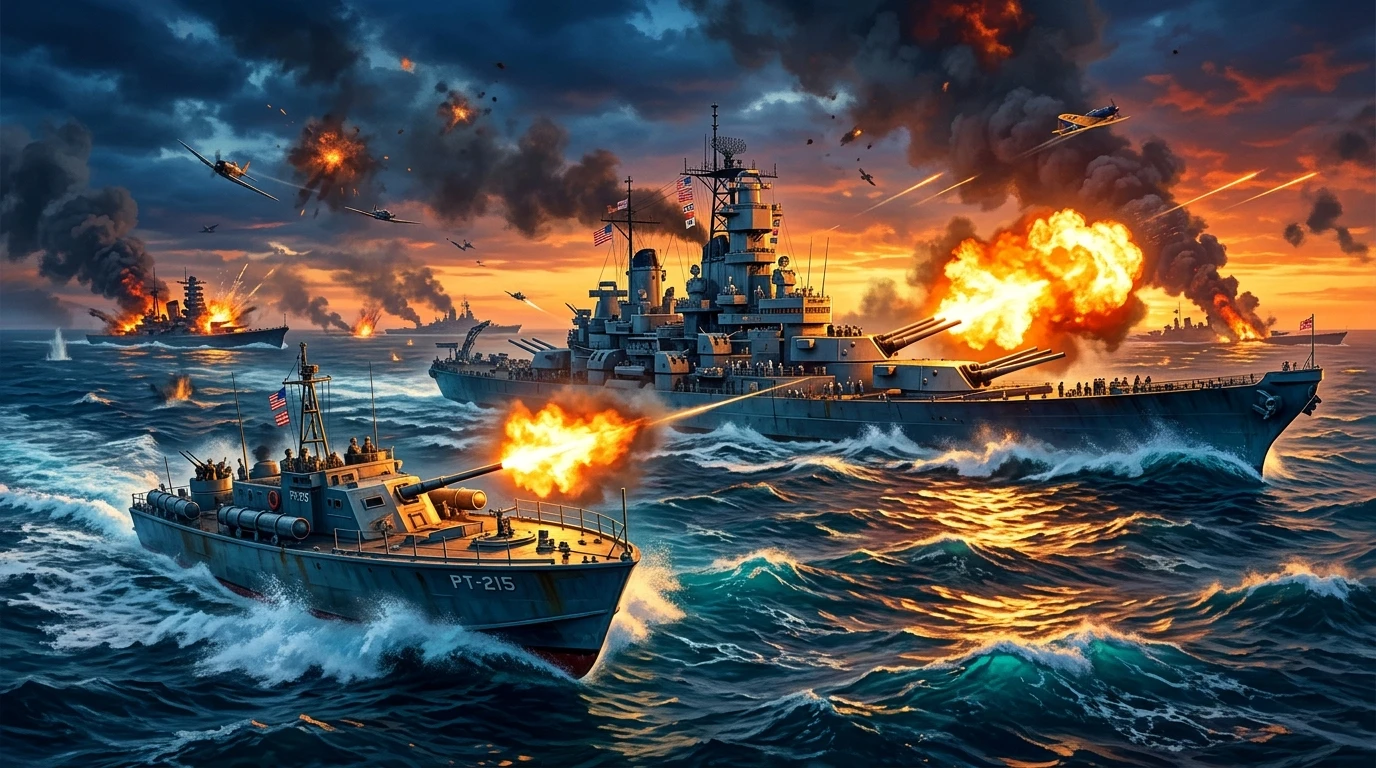
Top Admiral: Bringing WWII Aerial Dogfight DNA to an Endless Living Ocean
How we took Top Ace's arcade dogfight rhythm onto a procedural ocean: hydrodynamic drift physics, high-speed wave breaches, active CRT sonar, multi-turret dreadnoughts, and real-time Web Audio naval synthesis.
Right after shipping Top Ace, I found myself staring at the cloud-layer code and wondering what would happen if you pulled the camera all the way down to sea level. The aerial dogfighting loop in Top Ace worked because it stripped away altitude complexities and focused entirely on spatial discipline — gun heat, barrel rolls, and reading the CRT radar. But water isn't air. You can't roll out of a stall on a wave crest, and ships have mass, displacement, and wake turbulence that refuse to turn on a dime. Top Admiral was born from a simple question: what does a dogfight feel like when your battlefield is an endless, living ocean?
The physics of water: hydrodynamic drag and rudder drift
In early prototypes, the patrol boat handled essentially like a reskinned airplane: press left, turn left, move forward. It felt completely artificial. A boat cutting through open ocean doesn't just rotate its velocity vector; its hull pushes against thousands of gallons of water, generating bow spray, stern cavitation, and lateral slip.
I rewrote the movement model around two distinct vectors: the physical heading of the vessel and its actual momentum trajectory. When you crank the helm hard over at high throttle, the rudder redirects thrust, but inertial momentum keeps carrying the hull forward along its original line. The boat enters a deliberate drift, carving a wide foaming arc into the sea. Tuning the quadratic drag coefficient took days: too little drag and the boat felt like an air hockey puck on ice; too much drag and maneuvering felt sluggish and unresponsive. Where it finally landed is a rhythm where you steer through corners by feathering the throttle, sliding the stern out to line up twin deck guns on pursuing E-boats.
The wave breach slide: turning panic into tactical invulnerability
In Top Ace, the barrel roll was built to punish the instinctive urge to simply fly away from pursuers in a straight line. In naval warfare, the equivalent panic reflex is holding the rudder hard away when a spread of torpedoes appears on your flank. But against high-speed torpedoes and converging cruiser shells, pure outrunning almost always ends with a torpedo detonating amidships.
To solve that, I built the Wave Breach (triggered via Shift or C). By overloading the hydrofoils and slamming the rudder, your vessel executes a high-speed wave breach drift that kicks up a violent wall of spray and grants 0.85 seconds of total kinetic invulnerability. It allows a skilled skipper to power-slide directly through a torpedo fan, emerging behind the attacker with clear line of sight on their unarmored stern. Tying it to a 2.2-second cooldown ensures it remains a calculated tactical gambit rather than a get-out-of-jail-free button you can spam indefinitely.
Continuous resource tension without dead-stick ammo walls
I have always disliked traditional ammunition counters in endless arcade formats. Running dry on bullets mid-dogfight forces an awkward, anticlimactic retreat that grinds the game's momentum to a halt. Instead, Top Admiral balances firepower through three distinct operational rhythms:
- Twin 20mm Auto-Cannons & Gun Heat: You have unlimited ammunition, but sustained broadsides rapidly drive your barrel temperature into the red zone. If you overheat, the breeches jam for three full seconds. The optimal firing rhythm is controlled two-second salvos, timing bursts to coincide with the crest of a turn.
- Heavy Naval Torpedoes (R / Right Click): Slow, high-mass ordnance designed for capital ships and surfaced U-boats. A single torpedo deals massive structural damage, but the 2.2-second tube reload means missing an enemy cruiser leaves you vulnerable to return battery fire.
- Deployable Sea Mines (E): Floating moored explosives left in your trailing wake. When aggressive gunboats attempt to tail your slipstream, dropping a sea mine turns your wake into a lethal choke point, triggering devastating chain-reaction blasts.
The CRT sonar: diegetic tactical awareness
Because combat takes place across a boundless ocean, enemy flotillas routinely converge from off-screen angles. Placing bright neon arrows or floating off-screen indicator badges across the screen felt immersion-breaking and cluttered.
Instead, I integrated a functional 360-degree phosphor CRT Sonar radar directly into the tactical bridge HUD. The sweep rotates continuously, pinging every vessel within a 1,200-meter perimeter. Fast scout E-boats appear as frantic fluttering blips, submerged U-boats reveal their positions with faint acoustic trails, colossal Dreadnoughts register as heavy glowing contacts, and floating supply buoys pulse in reassuring emerald green. It provides complete tactical awareness while remaining faithful to 1940s naval bridge instrumentation.
Multi-turret modular dreadnoughts
When designing the game's flagship boss encounters — the Super Battleship Yamato and the Battle Carrier Colossus — I wanted to avoid monolithic health sponges that simply absorb gunfire until a number hits zero.
Each Dreadnought is engineered as a composite multi-turret warship with independent sub-systems. The Yamato features forward triple heavy artillery batteries, midship anti-aircraft flak guns, and aft torpedo launch tubes, each tracking the player independently. Rather than blindly firing into the main hull, you can deliberately target the forward cannons to disable their broadside barrage, or knock out the flak turrets to open an angle for high-speed torpedo runs. Dismantling a capital ship component by component turns what could have been a tedious damage race into an intense naval boarding action.
Fixing level transitions: from sudden spawns to cinematic operations
In the initial build of Top Admiral, when you destroyed the final enemy of a sector, the game simply incremented this.wave++ and immediately dumped the next wave of ships directly into the combat arena.
It was mechanically functional, but emotionally hollow. There was zero sense of accomplishment for surviving a brutal dogfight against an armored cruiser flotilla. You didn't even realize you had completed a sector — you were just suddenly being shot at by new enemies with zero breathing room.
We overhauled this completely with a dedicated two-phase Cinematic Sector Operation sequence:
- Sector Secured & Telemetry Breakdown: When the final hostile sinks, combat eases into smooth bullet-time glide. A triumphant four-note naval brass fanfare rings out alongside the ship's bronze bell. A tactical debrief card sweeps onto the bridge, celebrating your victory and tallying your combat performance: Sector Clear Bonus, Hostiles Sunk, and Salvage Recovered.
- All Engines Ahead Full & Navigational Course Plotting: Pressing Space (or waiting through the brief 2.8s tactical window) engages full engine throttle. Your ship surges forward, throwing up a foaming bow wake as the radar coordinates lock onto the next hostile perimeter. If the upcoming sector takes place under a Pacific Squall or Night Ops, the atmosphere, rain, and lighting transition smoothly across the living sea.
- Tactical Recon Briefing: As you enter the sector, a high-contrast reconnaissance banner slides into view, detailing hostile vessel types, threat level ratings, and primary mission objectives, culminating in a General Quarters klaxon if an enemy Dreadnought signature is detected.
This pacing change transformed the game completely. What previously felt like an endless treadmill now feels like a structured naval campaign where every completed sector feels earned and celebrated.
Synthesizing Pacific naval warfare in the Web Audio API
Stock sound effects from commercial sample libraries always suffer from the same problem in fast-paced arcade games: static pre-rendered waveforms don't respond to player physics, and overlapping identical samples cause horrible digital clipping.
Every sound in Top Admiral is synthesized dynamically in real time using the browser's Web Audio API, routed through a studio dynamics compressor and limiter:
- Procedural Marine Diesel Engine: Instead of looping an audio file, we generate a procedural 12-cylinder marine combustion buffer with staggered exhaust valve pressure pops and prop-wash displacement. As you throttle forward, the RPM pitch and lowpass filter sweep upward from a 220Hz idle rumble to a 480Hz high-speed roar, accompanied by a 28Hz sub-bass hull throb oscillator.
- Mechanical Deck Gunnery: The twin 20mm autocannons aren't simple beeps; they layer three discrete acoustic elements: a high-frequency bandpass noise burst (1,550Hz) simulating muzzle blast crack, a low-frequency concussive breech pop (75Hz → 32Hz), and a metallic bolt-cycle click. When upgraded to 40mm Bofors Cannons, the punch drops into deep resonant artillery territory (95Hz → 26Hz sub-bass boom).
- Hydrodynamic Explosions & Torpedo Plunges: Torpedo launches feature a pneumatic air-displacement hiss followed by water entry impact and turbine whine. Torpedo detonations hit with an earth-shaking 48Hz → 15Hz sub-bass shockwave and a turbulent foaming water geyser eruption noise.
- Nautical Bells & General Quarters Klaxons: From the resonant double-strike of a bronze ship's bell on sector departure to the pulsing twin-tone WWII naval battle stations klaxon when a Dreadnought breaks through the fog, diegetic audio signals tell you what's happening without requiring your eyes to leave the combat horizon.
What's next for the fleet
Building Top Admiral taught me that naval combat arcade games don't have to be slow, plodding artillery simulations. With tight hydrodynamic drift physics, responsive weapon cooling rhythms, active CRT sonar tracking, and punchy procedural audio synthesis, carving through an endless Pacific war zone can deliver every ounce of the kinetic rush that made Top Ace so special.
Future updates are already on the shipyard drafting table: call-in Allied Carrier airstrikes, coral atoll shore artillery batteries, and deep-sea mine-sweeper escort missions. Until then, keep your rudders greased, your breeches cool, and your sonar sweeping.
More from the Devlog