



















Drift Arena: The Guns Are Bolted On, So Sideways Is How You Aim
One constraint picked first and everything derived from it, a heat gauge inverted on purpose, and why walls stopped costing you health.
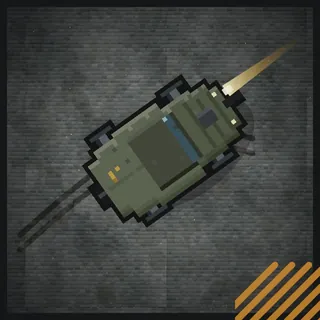
A top-down WWII vehicular combat game built on one constraint: your guns are bolted to the chassis. They fire where the car's nose points, not where you're travelling. That single rule is the whole design — it means the only way to shoot something you aren't driving directly at is to break traction and hold a drift, letting momentum carry you past while the nose stays on target. Drifting isn't a stylish optional extra here. It's how you aim.
One constraint, picked first, and everything else derived from it
The obvious version of a top-down car shooter gives you a mouse-aimed turret and lets you drive and shoot independently. That's a twin-stick shooter that happens to have wheels, and the driving ends up being something you do between the shooting. Bolting the guns to the chassis forces the two into the same action, and it turns out almost every other decision falls out of that. Enemies that track you with an independent turret become a real problem, because you can't out-turn one by driving in a straight line — you have to close. Bosses stop being health bars and become geometry problems: every one of the three has its weak point somewhere you physically cannot reach without circling it. I didn't design those bosses and then look for a justification. The constraint produced them.
The tyre gauge is inverted on purpose
Drifting heats your tyres. The intuitive version of that mechanic punishes you for the gauge filling up — a heat bar you're supposed to keep low, like the gun heat in Top Ace. I built it the other way round. Hot tyres grip better, charge nitro faster and score 1.5×, all the way up to 95%. Then at 100 they blow out and dump you into a two-and-a-half second slide with no steering.
The reason is simple: a gauge you're punished for filling is a gauge players learn to ignore. You glance at it once, decide "keep this low", and then never think about it again. A gauge you're rewarded for filling to 94% is a gauge you stare at. The best players in Drift Arena live in that orange band and never tip over, and that's a real skill with a real failure state, rather than a bar quietly draining in the corner. Same structural role as Top Ace's gun heat, opposite polarity, and I think the inversion is the more interesting of the two.
The Drift Kill, and why the score has to be at risk
Sustained drifting builds a score chain that is explicitly unbanked — it climbs to ×8 and sits there as a number you have not yet earned. Crash into a wall hard enough, or blow your tyres, and the whole thing evaporates. The way you cash it in is to kill something while still sideways, which banks it at ×1.5 and leaves the multiplier alive so the chain continues.
That's a press-your-luck loop layered onto a shooter, and it creates a legible risk curve rather than a vague "play well" incentive. At ×1.2 you can cash out safely and it barely matters. At ×6.5 with forty thousand points riding on it you are genuinely white-knuckled, hunting for anything at all to shoot before you clip something. The biggest chains come from drifting closest to the walls, which is exactly where you're most likely to lose them.
Walls stopped taking your health, and the game got better
Scenery used to cost armour. It felt terrible. In a game whose entire premise is sliding a car sideways through a bombed-out street at speed, clipping a wall is not a mistake worth a health bar — it's a normal part of driving on the edge, and charging for it made tight lines feel unfair rather than risky.
So walls now cost you nothing but speed. What they still do is break your chain, and that turned out to be the punishment that actually matters. You lose the forty thousand unbanked points, not twenty armour. The tension survives intact — arguably it's sharper, because the consequence is now the thing you were already thinking about — while the frustration is gone. Bridge edges are the one exception, and they still kill you outright, because that's a hazard rather than scenery.
The gunner is a deliberate compromise with the core rule
There's a crewman on a ring mount on your roof who covers all 360°, independent of where the car is pointing. He is, obviously, a direct softening of "your guns are bolted to the chassis," and I went back and forth on whether to include him at all.
What made him work was making him bad. At tier one he throws rounds inside a 26-degree cone and swings the mount so slowly he lags a crossing target by nearly sixty degrees. He's chip damage and area denial, not a weapon — the chassis gun out-damages him three to one, and that ratio is a thing I check rather than assume. His aim and his weapon upgrade on separate tracks, and by tier ten he's genuinely dangerous, but that's several thousand scrap away. The thing I'll be watching in the wild is whether a fully-kitted gunner ends up doing the work, because if he does, the drift-to-aim loop loses its teeth and I'd rather cap him than let that happen quietly.
A fixed timestep, because drift is exactly where you'd notice
The physics runs on a hard 1/120s accumulator with the rendering interpolated, rather than feeding raw frame deltas into the integrator the way most of my games do. The lateral-grip model decays sideways velocity exponentially, and with a variable timestep the identical input produces a visibly different slip angle at 45fps versus 144fps. For a plane that's a rounding error. For a game where the player is deliberately balancing a car at a 45-degree angle, it's the one thing they would feel immediately and never be able to describe.
The soundtrack is generated, not streamed
Every sound in the game is synthesised at runtime — the engine is a looping cylinder-firing buffer whose playback rate tracks RPM, and RPM rises mid-drift because the driven wheels are spinning faster than the car is actually travelling. Getting that one detail right does more to sell the mechanic than any amount of tyre squeal. Since the whole audio layer was already procedural, the music is too: a lookahead scheduler queueing a four-bar minor progression with a martial snare, and it leans harder on the brass when there are more hostiles near you. It ships as zero bytes of download, and it reacts to the fight, which a streamed track can't.
Eighteen levels across three zones, six objective types, three multi-phase bosses, six cars with distinct perks, and an endless Gauntlet feeding the leaderboard. Hold Space into a corner and see what happens.
More from the Devlog