

















Light Heroes: Five Kits, One Shared Economy
Grazing rewards the riskiest play, the Dojo tree has to close real doors, and I'm least confident about balance on this one out of today's three.
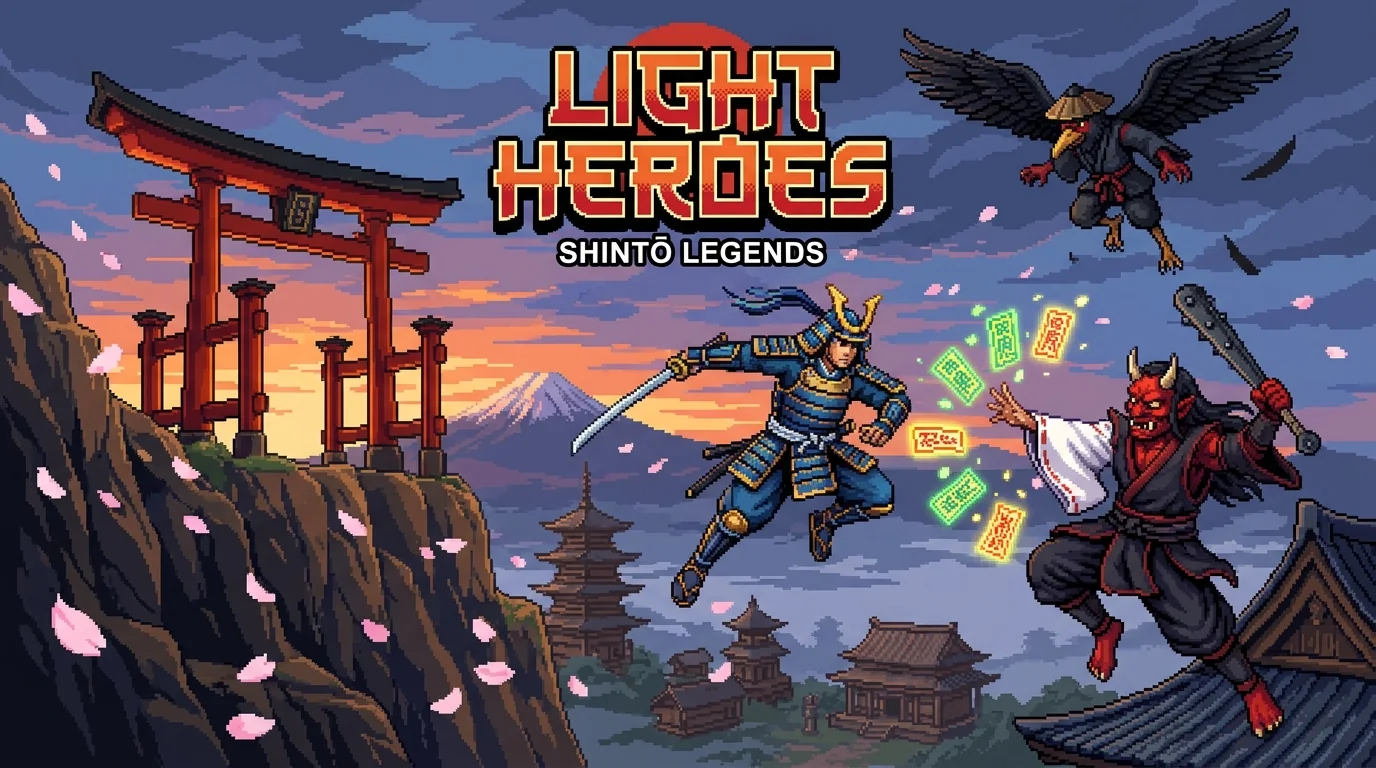
Five playable champions, a graze-to-charge magic gauge, and a full between-mission economy with a Blacksmith and a Dojo skill tree — this is the most systems-dense shmup I've built, and it's shipping the same day as Iron Atoll and Red Code: Quarantine, which made juggling three genuinely different games' worth of balance concerns at once its own small challenge on top of designing any one of them well.
Five champions had to feel meaningfully different in combat, not just cosmetically
A roster of five playable characters is only worth the content cost if switching between them actually changes how you play, not just how the screen looks. Each champion needed a distinct enough kit — different projectile patterns, different special skills, different ideal playstyles — that a stage that's a bad fit for one champion should genuinely feel more manageable on another. That's a lot of separate balance surface area to tune simultaneously, five complete character kits instead of one, and it meant accepting that some champions would launch stronger or weaker against specific enemy formations than others, rather than trying to make every champion equally capable against every single encounter in the game.
Grazing had to reward the highest-risk play, not the safest
Charging your magic gauge fastest by grazing enemy bullets closely, without taking the hit, is a deliberately risky mechanic to put at the center of the whole resource economy — it directly rewards flying closer to danger than a cautious player naturally would. I wanted magic charge to feel earned specifically through calculated risk, not handed out passively for simply surviving, since a magic gauge that fills at the same rate regardless of how aggressively you play would remove the entire point of grazing as a skill. The tension between playing it safe and grazing for faster charge is the actual core loop this game is built around, more than any single champion's kit or any single stage's layout.
A feudal Japanese aesthetic had to shape enemy design, not just decorate it
Flying Oni demons, armored samurai war-squads, kitsune spirits, and celestial Yokai lords could have been generic bullet-hell enemy archetypes wearing a themed coat of paint, and I wanted the mythology itself to actually inform how each enemy category behaves in combat, not just how it looks. Kitsune spirits move and attack differently from armored samurai squads specifically because the folklore they're drawn from suggests different behavior — trickery and misdirection versus disciplined, formation-based assault. That gave enemy design a real reference point to pull from beyond generic bullet-hell conventions, and it's part of why the five stages don't feel like the same enemy logic reskinned five times over.
The Blacksmith had to make repair feel like a real decision, not a tax
Between-mission repair costs real currency earned from battle spoils, which meant balancing repair cost against how much damage a mission realistically deals needed real care. Price it too high and repair becomes a punishing tax that makes every mission feel like it's digging a financial hole regardless of how well you played. Price it too low and armor degradation stops mattering at all, since repairing back to full is trivially cheap every time. I wanted a genuinely damaged run to create a real, felt trade-off at the Blacksmith — repair fully and go in clean, or repair partially and gamble on the next mission being more forgiving — rather than either extreme collapsing the decision into an obvious, thoughtless choice.
The Dojo skill tree needed choices that actually closed doors
Allocating skill points in the Dojo only feels meaningful if committing to one path genuinely means not having invested in another, at least for a while. A skill tree generous enough that everyone eventually unlocks everything makes early choices feel inconsequential, since they're just temporary orderings rather than real trade-offs. I built enough real scarcity into point allocation that an early Dojo choice actually shapes how a champion plays for a meaningful stretch of missions, not just for the first stage before the tree opens back up and every path converges into the same fully-unlocked build anyway.
Bullet-hell density had to stay readable around five different projectile patterns
A bullet-hell shmup lives or dies on whether a screen full of enemy fire stays visually parseable at speed, and having five champions each with their own projectile patterns and visual effects added real risk of the screen becoming genuinely unreadable once a champion's own effects layer on top of an already-dense enemy bullet pattern. I had to keep each champion's visual signature distinct enough from typical enemy bullet colors and shapes that a player can still track incoming danger clearly regardless of which champion they're playing or how visually busy that specific champion's kit gets during a big special-skill activation. Losing to a bullet you genuinely couldn't parse in time is a much worse failure than losing to one you saw clearly and misjudged.
Multiple save slots mattered more once five champions existed
Full profile saving across multiple slots became a real requirement the moment there were five distinct champions worth building up separately — a single save slot would force anyone curious about a second champion to either abandon their first character's progress or never actually try anyone else. Multiple slots let someone maintain a fully-built main champion while genuinely experimenting with a second build on the side, which felt necessary specifically because of how much between-mission progress — repairs, Dojo points, gear — accumulates per character in this game compared to anything else I've shipped so far.
Of the three games launching today, this is the one I feel least certain about the balance of, purely because it has the most moving parts — five kits, a shared economy, a skill tree, and a magic resource all interacting at once. I'd rather say that plainly now than pretend a system this dense came out perfectly tuned on the first real attempt. Some of it will need real adjustment once actual play surfaces which champion or which Dojo path is quietly stronger than the rest, which is a much better source of truth than any amount of my own solo testing.
More from the Devlog