

















Perilous Stacks: Real Physics, On Purpose, Even Though It's Harder
Frost Stack's overlap-check made a deliberate, different trade-off — this one commits to genuine rigid-body physics and the unpredictability that comes with it.
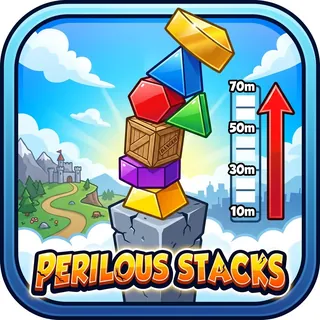
Three random shapes dealt at a time — cubes, planks, wedges, arches, T-pieces — stacked as high as possible above a bottomless pit on either side, with real-time rigid-body physics governing every drop. Unlike Frost Stack's simplified overlap-check approach from back in May, this one commits to full physics simulation, which meant accepting a genuinely different and harder set of engineering problems from day one.
Choosing real physics over overlap-check was a deliberate departure, not an upgrade
I want to be clear that full rigid-body physics isn't objectively better than Frost Stack's simpler overlap system — it's a different trade-off suited to a different game. Frost Stack's deterministic overlap check gives precise, repeatable feedback well suited to a fast-paced climbing game. Real physics gives Perilous Stacks something overlap-check can't: genuine, emergent instability — a stack that's leaning can visibly wobble, and a poorly balanced piece can slide and tumble in ways that feel like a real physical failure rather than a clean pass/fail determination. That unpredictability is exactly what this particular game is built to showcase, even though it comes at the cost of the precise, deterministic feedback overlap-check gives Frost Stack.
Five shape types needed genuinely different balance behavior, not just different silhouettes
Cubes, long planks, wedges, arches, and T-pieces each interact with gravity and existing structure differently under real physics — a long plank has a much larger tipping moment than a cube of similar mass, a wedge naturally wants to settle at an angle rather than flat, an arch can rest stably in configurations a solid block never could. Getting a real physics engine to make all five shapes behave believably different, rather than having the underlying simulation treat every shape as an interchangeable bounding box with a different mesh drawn on top, was necessary for advice about orientation — wedges and arches balancing more easily flat-side-down — to actually be true rather than invented advice that doesn't match how the simulation really behaves.
Dealing three shapes at a time changed planning, not just pacing
Seeing three shapes in hand before needing to place any of them lets a player plan a short sequence rather than reacting to one piece at a time in isolation — deciding to place an awkward shape now because you know a stabilizing one is coming right behind it, for instance. That's a meaningfully different cognitive demand than a single-piece, one-at-a-time format, and it's why I'd tell anyone starting out not to rush the third piece just to see the next set: the temptation to treat the third piece as disposable, since a new hand is coming regardless, is real, and rushing it is exactly how an otherwise well-planned three-piece sequence ends in an avoidable fall.
The rising camera had to make altitude feel earned, physically
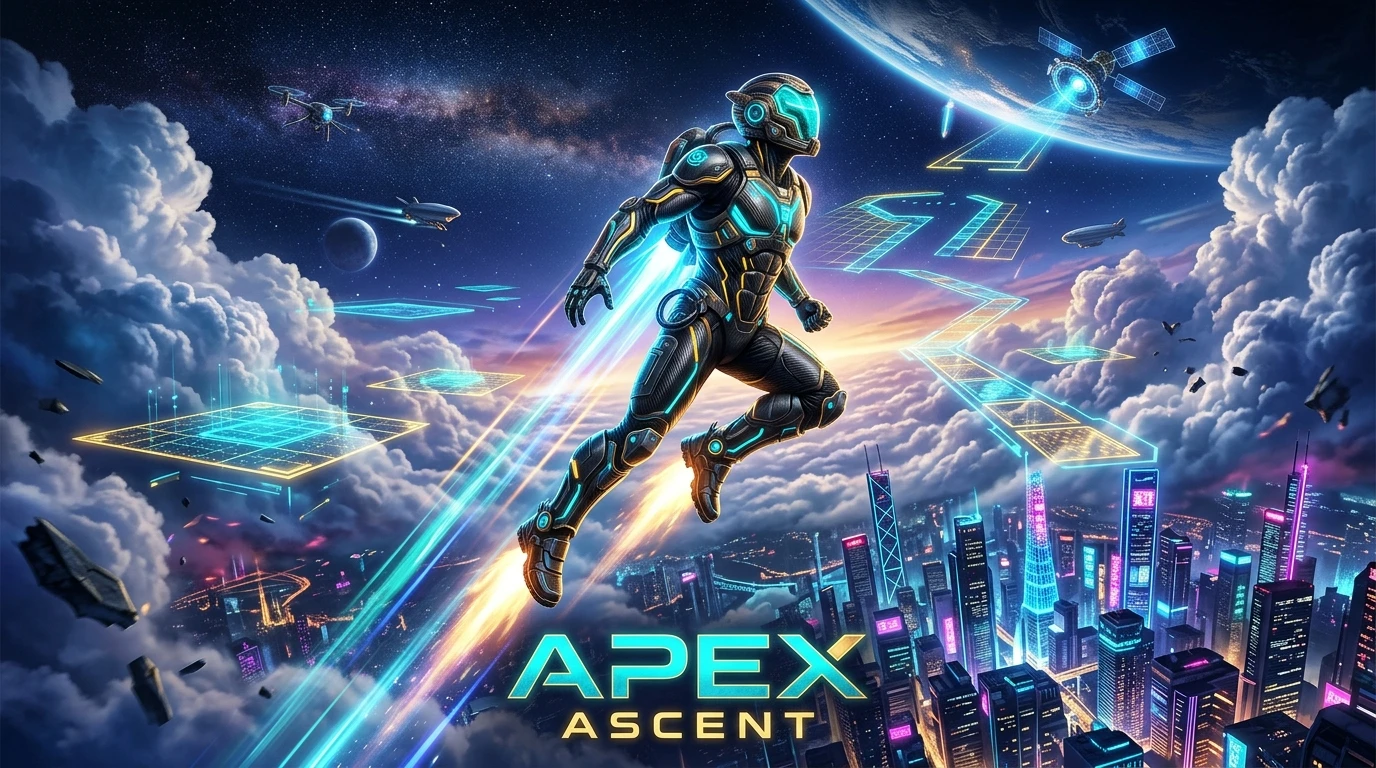
Following the ascent through sunny clouds, into the sunset stratosphere, and finally into cosmic space uses the same escalating-zone idea Frost Stack introduced in August, applied to a very different physical simulation underneath. What's different here is that the camera has to track a tower that can genuinely wobble and shift as physics settles, not just a number going up cleanly. Getting the camera to follow real, slightly unstable structure smoothly, without motion that reads as jittery or nauseating, took real tuning separate from anything the altitude-zone visual concept itself required.
Rotation controls needed to feel precise despite the physics underneath being genuinely unpredictable
Rotating a shape to find its balance angle has to feel like a precise, controllable action even though the eventual physical outcome once it's dropped carries genuine simulated uncertainty. That's a real tension — a player needs to feel like careful rotation and alignment genuinely matters, while the actual physics engine underneath is simulating real contact forces that can still produce a surprising result even from a well-aligned drop. I tuned rotation input to feel immediate and exact, so any unpredictability a player experiences clearly traces back to the physics of the drop itself, not to sloppy or imprecise control input fighting them on top of it. Blaming the physics for a fall should always feel more accurate than blaming the controls.
Why the fall has to look like a real collapse, not a game-over screen
When a piece finally slips off the platform into the pit, the camera tracks it tumbling down into the abyss rather than cutting immediately to a results screen. That's only possible because the physics simulation is real — a scripted fall animation would have to fake exactly the kind of tumbling collapse that genuine rigid-body physics produces automatically once a piece actually loses its footing. The ending sequence isn't a separate thing I built on top of the physics engine; it's the physics engine doing what it was already doing the entire run, just now producing a dramatic failure instead of a successful stack.
Between this and Frost Stack, the site now has two genuinely different answers to the same basic pitch — drop shapes, build a tower, don't let it fall — and I think that's a good thing rather than a redundancy. One is precise and deterministic; this one is physical and occasionally surprising even to me watching it happen. Different players are going to prefer different flavors of that same core idea, and building both rather than picking one felt like the more honest response to that than pretending there's one objectively correct way to do a stacking game.
Building this so soon after Frost Stack also meant I already had a clear point of comparison in mind the whole time, which shaped a lot of the smaller decisions — the queue-of-three dealing system, the escalating visual zones — as deliberate contrasts against what Frost Stack already does well, rather than reinventing every piece of the format from scratch with no reference point to push against. Having a real sibling to compare against made every one of those decisions easier to reason about than building this in a vacuum ever would have been.
More from the Devlog