














Turbo Grand Prix: Faking 3D and Meaning It
Eight hand-built tracks, a drift-boost curve tuned to reward commitment, and keeping keyboard, buttons, and touch equally precise.
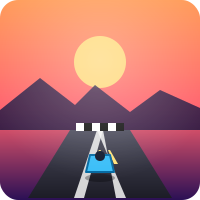
Eight tracks, two cups, three difficulty levels each, and a rendering trick borrowed straight from SNES-era racing games to fake a rolling 3D perspective out of flat track art. This is the most visually ambitious game I've built for the site, and almost none of that ambition is actually happening in three dimensions.
Eight hand-built tracks instead of a generator
I considered procedurally generating tracks rather than hand-building all eight, and decided against it, mostly because a drift-boost game lives or dies on whether specific corners are placed to reward specific drift techniques — a wide sweeping turn that rewards a long charge, a tight chicane that rewards a quick tap-and-release. That's exactly the kind of intentional, curated design a generator would struggle to produce reliably. Hand-building all eight took longer, but it meant every track could be tuned specifically around teaching or testing a particular facet of the drift mechanic, rather than hoping a procedurally generated layout happens to create interesting corners by chance.
Faking 3D is its own genuine craft, not a shortcut
The pseudo-3D "Mode 7" style trick works by tilting and scaling flat track art to simulate a road rolling away into the distance, without ever building an actual 3D scene or camera. It's a genuine technique with real constraints, not a lazier version of true 3D — getting the scaling and perspective math to feel convincingly like a road receding into the horizon, rather than an obviously flat image being stretched, took real tuning of exactly how track segments scale and shift as the camera's implied position moves forward. Done sloppily, this style of rendering looks distinctly wrong in a way most people can point at even without knowing why. Done carefully, it reads as a deliberate retro aesthetic instead of a rendering compromise.
Drift-boosting had to reward commitment, not button mashing
Holding a drift through a turn charges a mini-turbo that launches you forward on release, and the core tuning question was how long a charge should take and how much boost it should reward. Too fast a charge and drifting becomes something you do reflexively on every turn with no real skill involved; too slow and drifting stops feeling worth the risk of losing your line through the corner while you wait for the charge to finish. I wanted a player who commits early to a drift and holds it cleanly through the whole turn to be rewarded meaningfully more than one who taps in and out nervously, which meant the charge curve needed a real, felt difference between a rushed drift and a properly held one, not just a binary charged-or-not state.
Chaining drifts is where the skill ceiling actually lives
The real difference between a mediocre lap and a strong one isn't any single drift, it's carrying momentum from one drift-boost directly into the next corner's drift without braking and resetting speed in between. Getting that chaining to feel achievable, not just theoretically possible, meant making sure momentum genuinely persists between consecutive turns rather than the game quietly normalizing speed back to some baseline between corners. That's the entire skill ceiling this game is built around — anyone can complete a lap on the Rookie cup driving cautiously, but stringing drift-boosts together through the harder Champion-cup circuits is a distinctly different, higher skill that takes real practice to develop.
The Garage had to make upgrades feel meaningfully different, not just bigger numbers
Coins from winning races buy upgrades to speed, acceleration, handling, and boost, and a flat, generic "everything gets 5% better" upgrade path would have made the Garage feel like busywork rather than a real strategic layer. Handling upgrades specifically needed to matter more than raw top speed for actually getting faster lap times, since better handling lets you carry more speed through corners without spinning out — which is a subtler, more interesting trade-off to communicate than "bigger number wins." Getting players to actually feel that handling matters more than top speed, rather than just telling them so in a tip, meant the corner physics themselves had to genuinely reward good handling stats, not just have them exist as a number on a screen.
Splitting into two cups instead of one long ladder
Eight tracks could have been one continuous progression from easiest to hardest, and I split them into a Rookie cup and a Champion cup instead, each with its own three difficulty levels. That structure gives players a genuine sense of graduating from one skill tier into a clearly distinct next one, rather than just a long, undifferentiated ladder where track five feels arbitrarily harder than track four for no particular reason. It also meant designing the Champion cup's tracks specifically to demand the drift-chaining skill the Rookie cup is meant to teach, rather than just scaling up the same track design philosophy with tighter turns — the Champion cup earns its name by actually requiring mastery of the mechanic the Rookie cup exists to introduce.
Why touch controls got equal priority from day one
Supporting keyboard, on-screen buttons, and touch controls all at launch, rather than treating touch as a lesser afterthought retrofit, mattered specifically because drifting is the entire skill of this game and drifting needs precise, well-timed input regardless of what device someone's playing on. A racing game where the keyboard experience feels tight and the touch experience feels mushy and imprecise would be telling a meaningful chunk of players that the actual skill this game is built around isn't really available to them. Building all three input methods against the same drift-timing requirements from the start, not sequentially with touch added later as a compromise, was the only way to make sure that wasn't true.
This one took longer than most of what I've shipped, and I think it needed to. Faking convincing 3D, tuning a drift-boost curve that actually rewards commitment, and keeping three input methods equally precise are each their own real problem, and stacking all three into one launch is more ambition than most of what's come before it on this site. Whether that ambition actually lands is something only real races, on real tracks, against real opponents, is going to answer, not a design document written before any of it existed, and not my own laps around a track I already know well enough that every turn feels easier to me than it will to someone seeing it cold for the first time, drift timing included.
More from the Devlog